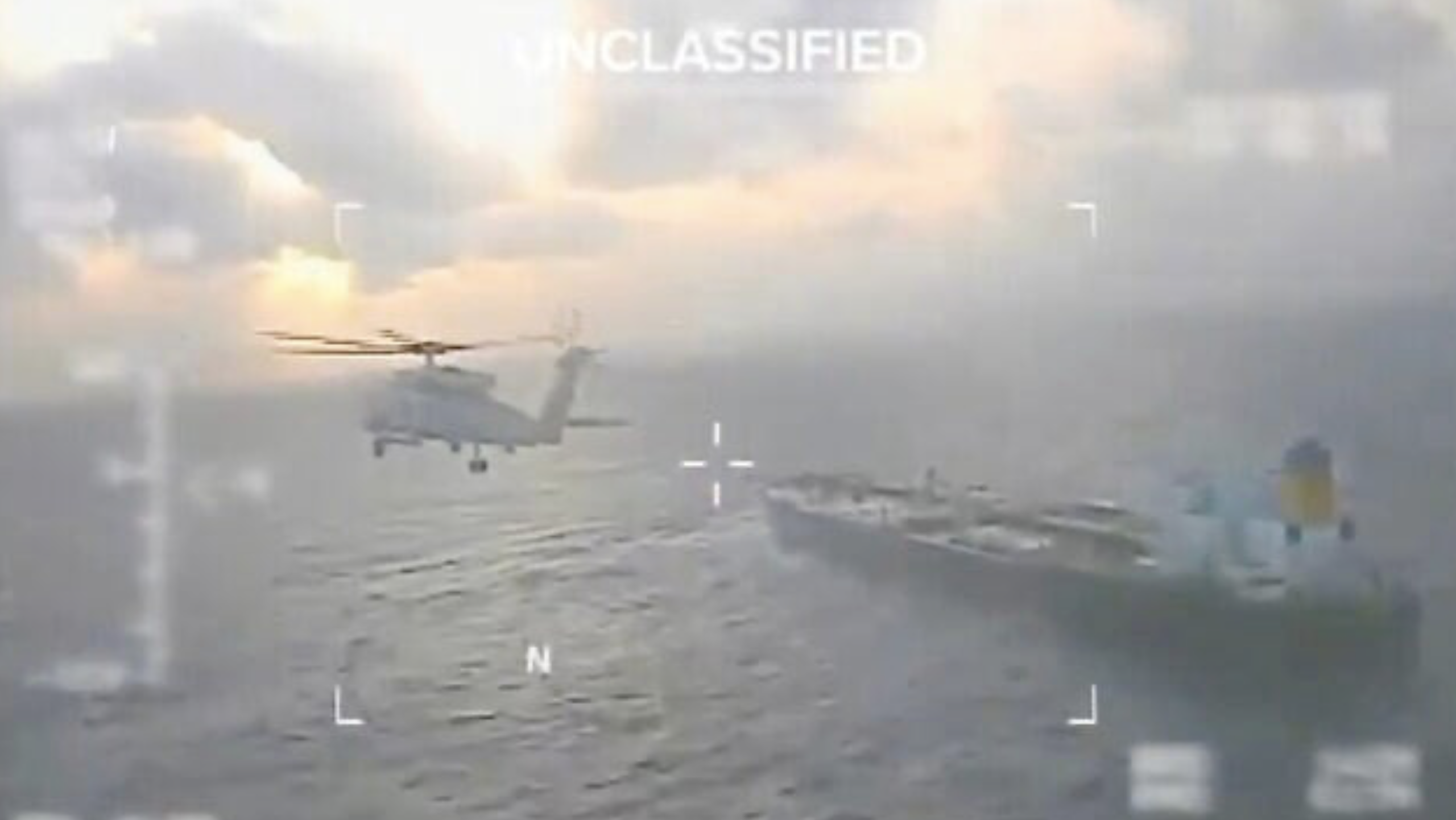
U.S. Coast Guard officials are actively tracking a sanctioned oil tanker in international waters near Venezuela, marking the third such incident in a week, according to U.S. officials cited by the Associated Press and Agence France-Presse.
The pursuit follows the seizure of another tanker a day earlier, as the Trump administration intensifies enforcement actions against vessels tied to Venezuela’s oil trade after the president declared a “blockade” on sanctioned tankers entering or leaving the country. Newsweek reached out to the U.S. Coast Guard and Venezuela’s foreign ministry for comment.
What Happened
- U.S. officials said Sunday that the Coast Guard was engaged in an “active pursuit” of an oil tanker in the Caribbean Sea near Venezuela, according to reporting by the Associated Press and Agence France-Presse.
- Officials described the vessel as a “sanctioned dark fleet” tanker allegedly involved in sanctions evasion.
- The ship was flying a false flag and was subject to a judicial seizure order, according to unnamed U.S. officials.
- Multiple outlets, including The New York Times, identified the vessel as the Bella 1, an oil tanker placed under U.S. sanctions in 2024 over alleged ties to Iran and Hezbollah.
- U.S. forces approached the tanker late Saturday, but the vessel did not submit to boarding and continued sailing, officials told the New York Times.
- According to maritime intelligence firm TankerTrackers, the vessel was en route to Venezuela but was not carrying cargo.
Why It Matters
The pursuit underscores a sharp escalation in U.S. enforcement against vessels linked to Venezuela’s oil exports, a crucial revenue stream for President Nicolás Maduro’s government, and highlights growing risks to global energy markets and maritime security.
The actions also reflect a broader U.S. effort to disrupt sanctions evasion networks operating across the Caribbean, increasing the likelihood of diplomatic friction and potential confrontation at sea.
What They’re Saying
White House National Economic Council Director Kevin Hassett said Sunday on CBS News’ Face the Nation that the first tankers seized were operating illegally.
“They were black market ships,” Hassett said, adding that he did not expect the seizures to drive up U.S. oil prices.
An oil trader, however, told Reuters that the seizures were likely to push prices higher when Asian markets reopen, though expectations of a potential end to the war in Ukraine could help limit further increases.
Republican Sen. James Lankford of Oklahoma said Sunday on CNN’s State of the Union that he would support U.S.-backed regime change in Venezuela, arguing that Maduro “is not the recognized leader of Venezuela.”
Context / Background
U.S. forces seized an oil tanker off Venezuela’s coast on December 10, followed by the apprehension of a second merchant vessel carrying oil on Saturday, according to the Department of Homeland Security. Both vessels were reportedly bound for Asia, according to U.S. officials cited by Reuters.
Trump recently declared a “blockade” targeting all sanctioned oil tankers traveling into or out of Venezuela. The pressure campaign has included a heightened U.S. military presence in the region and more than two dozen military strikes against vessels in nearby waters, according to prior reporting by Reuters and the Associated Press.
After the first seizure, Venezuela’s government accused the United States of “blatant theft”, calling the action “an act of international piracy.”
What Happens Next
U.S. officials said the situation involving the Bella 1 remains active, while Maduro has urged Venezuela’s navy to escort oil tankers, raising the risk of confrontation as the U.S. deploys its largest regional fleet presence in decades.
Further enforcement actions could intensify geopolitical tensions and disrupt oil shipments, particularly those bound for Asian markets.