The U.S. Army inaugurated a new 155mm artillery munitions facility in Mesquite, Texas, in May 2024, marking a significant expansion of domestic ammunition production driven by the Ukraine war. The more than $500 million plant is part of a multibillion-dollar effort to expand production capacity depleted by supplying Ukraine’s defense against Russia’s invasion.
Texas Facility Opens
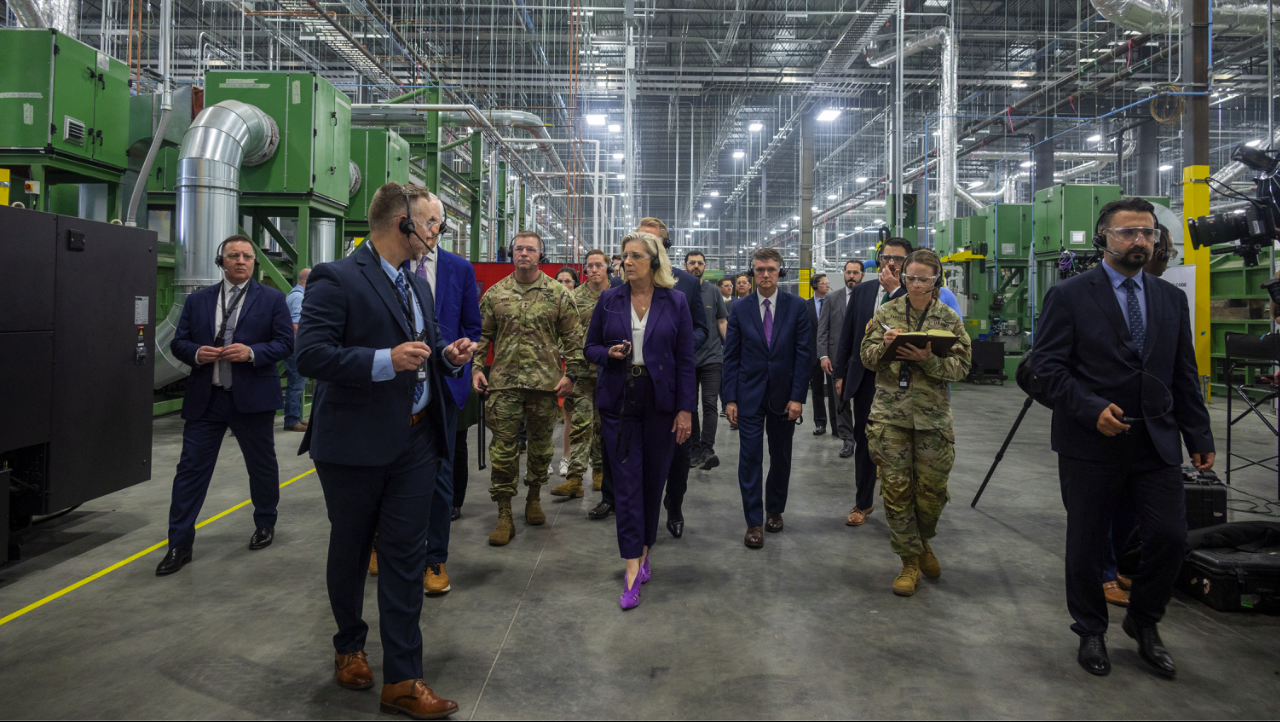
The Universal Artillery Projectile Lines facility in Mesquite, managed by General Dynamics Ordnance and Tactical Systems, represents a more than $500 million investment funded through supplemental spending bills from fiscal years 2022 and 2023, according to Reuters. The plant features advanced manufacturing technologies and automation for producing large-caliber metal parts.
“The work done in these production facilities contributes directly to our nation’s defense and makes us stronger,” Army Secretary Christine Wormuth stated at the opening ceremony in May 2024.
The facility is part of a broader effort by the Army to achieve a production goal of 155mm artillery shells at a rate of 100,000 per month, up from approximately 14,400 shells per month before Russia’s February 2022 invasion of Ukraine.
Production Expansion Nationwide
The Army opened a second major facility in Camden, Arkansas, in April 2025 to load, assemble and pack 155mm high-explosive artillery munitions, according to Army Times. Once fully operational, the Camden facility’s two new production lines will be able to produce approximately 50,000 rounds each month.
“The Army must transform and get war-winning capabilities into the hands of soldiers now, including key munitions,” said Army Secretary Dan Driscoll. “The Army remains committed to delivering relevant munitions at speed and scale to our soldiers, the joint force, and allies and partners.”
The Scranton Army Ammunition Plant in Pennsylvania underwent a massive expansion fueled by millions of defense spending, investing in new high-tech machinery, hiring additional workers and shifting to a 24/7 schedule. The facility produced approximately 11,000 artillery shells per month before the expansion, according to CNN.
Supply Chain Challenges
Demand for 155mm artillery rounds soared following Russia’s invasion of Ukraine in February 2022. Ukrainian forces fire thousands of rounds per day, but Western allies’ supplies for their own defense were run down as they rushed shells to Kyiv.
The U.S. Army has been working to diversify its supplier base for 155mm artillery shells, moving away from single-source bottlenecks that endangered ammunition flow, according to Army acquisition chief Doug Bush. The service set a goal of shoring up all major single sources that provide parts or materials for 155mm munitions by the end of 2025.
“There’s going to be a lot of ribbon cuttings between now and the end of the year,” Bush told Defense News in October 2024.
By mid-2025, the Army was producing 40,000 shells per month, though officials acknowledged the service had fallen slightly behind its 100,000-per-month target schedule.
Industrial Base Investment
Of the $113 billion appropriated by Congress through 2024 related to the conflict in Ukraine, as much as $68 billion was destined to be invested in the United States, according to the Center for Strategic and International Studies. The spending offered an opportunity to address long-standing weaknesses in U.S. defense industrial base systems, particularly ordnance and missile production.
The Pentagon invested billions of dollars to increase 155mm munition production capacity to replenish stock sent to support Ukraine and ensure the U.S. has adequate supplies should conflict erupt across multiple theaters. The Army planned to spend $3.1 billion in fiscal 2024 supplemental funding alone to ramp up production.
Historical Context
A decade of strategic, funding and production decisions played a significant role in the ammunition shortage, according to a Reuters investigation. Between Russia’s 2014 seizure of Crimea and its 2022 invasion, repeated warnings from top NATO commanders and officials who operated U.S. munitions plants went largely unheeded.
Many artillery production lines at already-ancient factories in the United States and Europe slowed to a crawl or closed altogether during this period due to lack of demand and investment.
“This is a problem that’s been long in the making,” said Bruce Jette, who served as assistant secretary of the Army for acquisition, logistics and technology from 2018 to January 2021.